
Trackeen
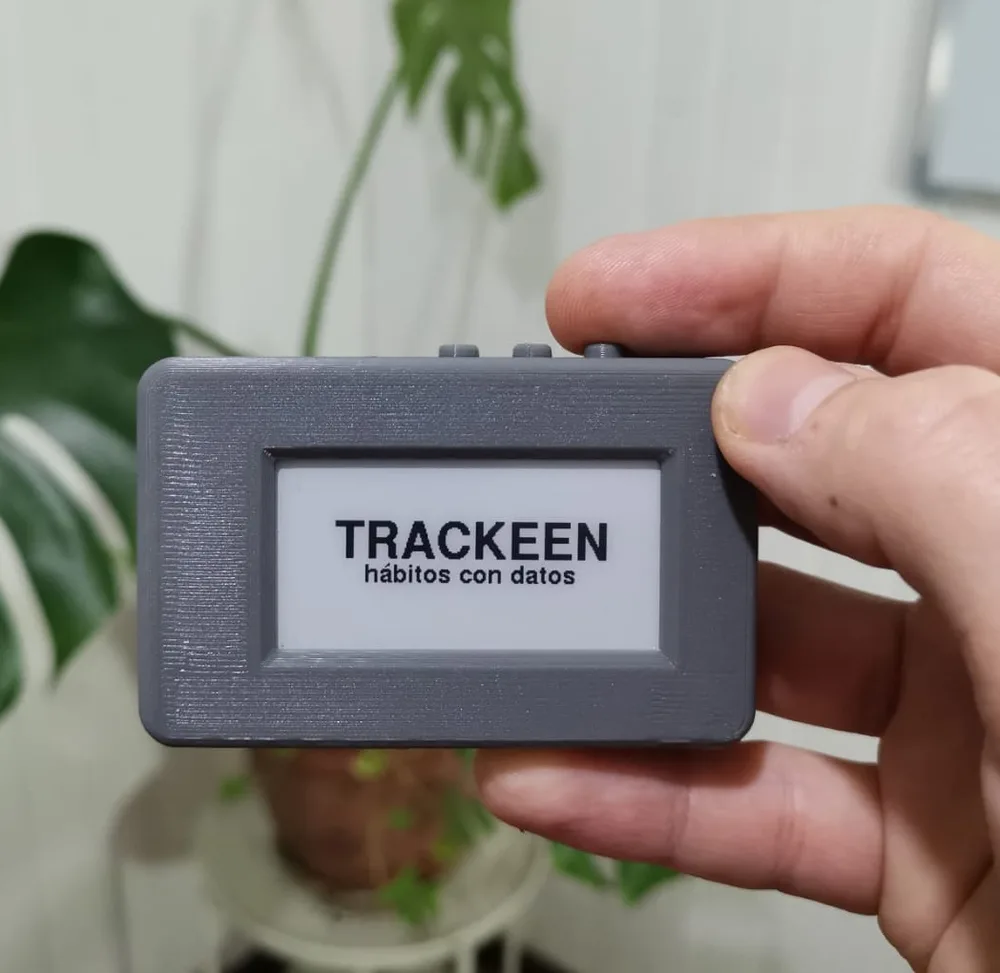
A Kindle-style device with E-paper display: no radiation, long battery life, and none of the smartphone addiction. Comes with 3 months of habit coaching.
I've been tracking my habits since 2020. It started on paper, then I moved to a spreadsheet that kept getting more complex, until I was logging more than 50 items every single day. Keeping that system up by hand got heavier and heavier: entering fifty data points a day ended up being more work than the habit I was trying to build.
The hypothesis was simple: the problem wasn't willpower or method, it was the friction of logging the data. If tracking lived outside the phone, on a device built for exactly one thing, people could actually stick with it without fighting the same distractions that sabotage every new habit.
One day I showed my spreadsheet to a friend, @caco_viajero. His reaction was instant: this is awesome, I want something like this too, but simpler. That's where the project kicked off, together with TheAndiHaller, who I'd wanted to build a TrackerCube with for a long time. We threw together a quick Arduino prototype, validated that we could send data over WiFi straight into a Google Sheet, and from there everything started to flow.
We targeted people who want to build habits but keep getting lost in their phones: the same screen that has WhatsApp, Netflix and social media can't be the tool for self-improvement. Trackeen is a single-purpose device with E-paper technology: no radiation, long battery life, and none of the dopamine loop that makes smartphones so addictive.
The model was simple: sell the device with 3 months of habit coaching included (roughly how long it takes to install a new habit), supporting the person on up to 5 habits at a time, with monthly check-ins to review the data and adjust whatever was needed. All for $250. The first three clients paid just $100 for the hardware.
With the money from those first three early adopters, we bought our first 3D printer. Over time we reached more than 10 clients and shipped Trackeen as far as Mexico and Uruguay: the clearest sign that the problem resonated beyond Chile.
Past 10 clients, the cracks in the model started to show. Data entry on the device, the exact problem we were trying to solve, still wasn't frictionless: people forgot the Trackeen, or just didn't charge it. The $250 pack turned out to be too cheap for what it cost to sustain: the coach was basically working for love of the cause.
Shipping became another headache: we ended up charging more than $60 extra just to send a Trackeen to Mexico or Uruguay. By the end of 2024 we decided to pause. We never came back from that pause: the project just ended.
We understood the user's pain (data entry) and we understood people wanted to build and sustain habits. What we didn't understand in time was the size of the niche: the number of people willing to value the data, the graphs, and a dedicated physical device was a lot smaller than we thought. It wasn't a product problem, it was a market problem.
We fell so in love with the product (the "Kindle for habits" idea) that when several users asked us for a phone app, or something simpler over WhatsApp, we said no: that was exactly the point of the device, pulling you away from the biggest distraction on the planet. In hindsight, we could have tried a lighter channel without betraying the core idea. The AI know-how that would have made that possible (a simple, frictionless bot) only showed up a year after Trackeen.
Habit-tracking apps compete with everything else on your phone: notifications, social media, messages. Every time you open the app, your focus drifts. Trackeen is a standalone device with one single purpose: log your habits for the day.
With an ultra-low-power e-ink display, physical buttons and automatic sync to Google Sheets, it combines the simplicity of a notebook with the power of the cloud. Weeks of battery life on a single charge, and no extra apps to install.
- ESP32
- C++ / PlatformIO
- E-ink display
- WiFi
- OAuth2
- Google Sheets API
- OTA Updates
- Low-power design
I was responsible for the full firmware architecture in C++ with PlatformIO. The ESP32 microcontroller handles the main logic, WiFi connectivity and communication with the e-ink display. The low-power design relies on aggressive sleep modes between user interactions, which is what makes the battery last weeks on a single charge.
The Google Sheets integration uses OAuth2, meaning users can view their habit history from any device (phone, laptop or tablet) without installing anything. Data is uploaded automatically in the background whenever the device connects to WiFi.
The system supports OTA (Over-The-Air) updates: new firmware versions reach the device over WiFi with no cables required. This allowed us to iterate fast during development and keeps the update process simple for end users.