
Tridibot Robot
A 3D-printed quadrupedal robot you can control over WiFi from any device on the same network.
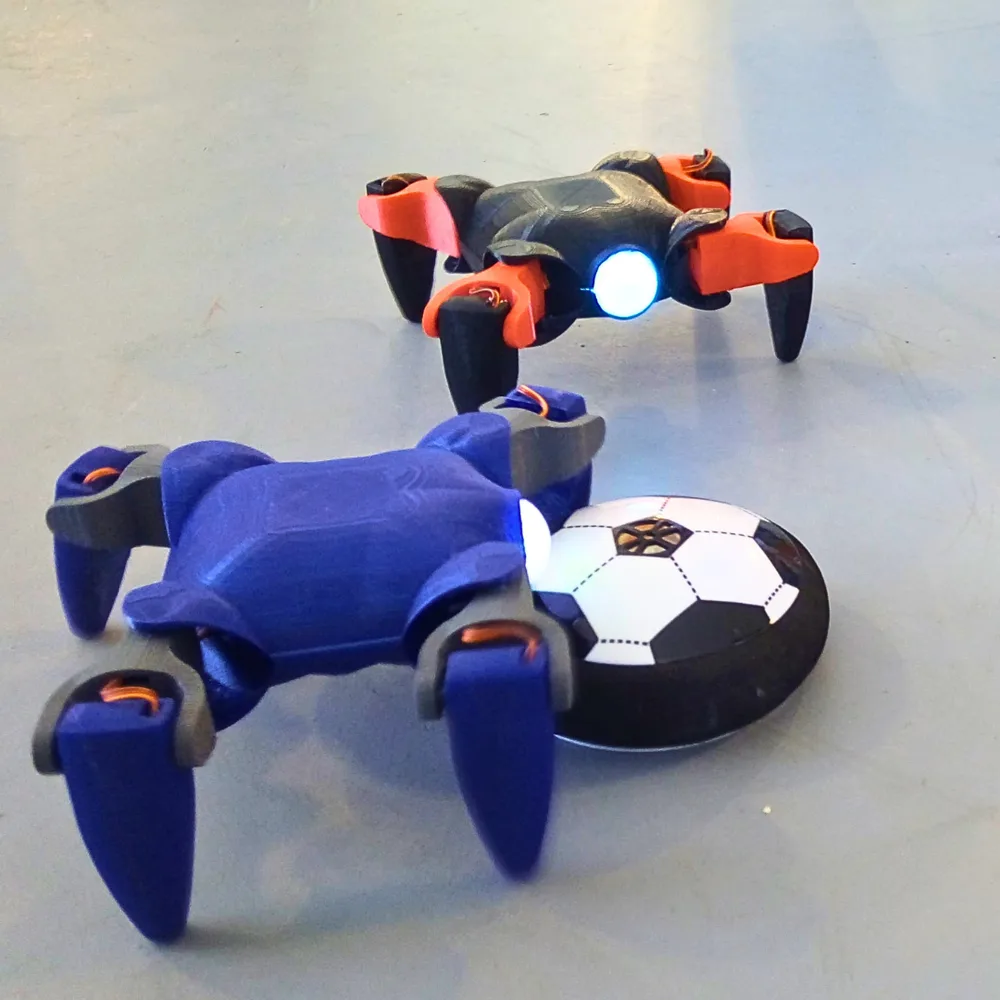
It all began through Kaiwa-Tech. The National University of San Luis found us at a Campus Party event in Buenos Aires, where they saw us in action. They bought several kits, we worked together through that process, and gradually earned their trust.
With that relationship built, the commission arrived: design a robot for teaching programming to primary school kids. The requirements were clear: visually striking, no exposed wires, embedded battery, controllable from a smartphone. Deadline: 4 months. They would debut it at the big robotics competition in San Luis, covering our travel and event expenses.
My friend Andi and I took the challenge. We were all in.
With that competition-debut validation in hand, we decided to take the next step: bring the robot to market and test for real demand beyond the classroom.
We designed a wooden packaging (aesthetic, carefully crafted), calculated costs with margin, and landed on a retail price of ~$500 USD. We manufactured 8 units by hand.
Tridibot's debut at the big San Luis robotics competition was a full success: it made a real impact and confirmed there was something worth pursuing there. It was the validation we needed to take the leap from academic project to market product.
- 2 of 8 robots sold out of the units manufactured
The feedback was always the same: "Wow, so beautiful!" followed by "Wow, so expensive!". The appeal was real. The price was a wall.
Tridibot was too handmade of a product. Every unit was built piece by piece, making it impossible to lower the cost without killing the margin. The logical next step (contracting mass manufacturing for the boards and casings in China) never happened, mainly because we didn't have that experience at the time.
On top of that, we were too focused on making a profit from the very first units, when what we actually needed was simply to validate.
The right approach would have been to accept upfront that the first units were going to lose money (or at best break even) in exchange for validating demand, user experience, and real market signals.
With that foundation in place, the natural path would have been to launch a Kickstarter campaign to fund mass production. That's how hardware is done: learning first, scale second.
It started with a request from a university teacher who wanted a robot capable of engaging students in the classroom and introducing them to robotics and programming in a fun, hands-on way. The goal: something that doesn't just get programmed, it moves, reacts, and surprises.
We chose a four-legged design over wheels to get more expressiveness and agility. We prioritized wireless connectivity, low cost, and replicability using common, accessible materials. The result is a fully open-source robot that anyone can build, customize, and program.
- ESP8266
- Arduino Nano
- 3D Printing
- RGB LED
- WiFi
- Serial
- Li-ion Battery
- Arduino IDE
The robot runs two microcontrollers: an ESP8266 that handles WiFi connectivity and receives commands from any device on the same network, and an Arduino Nano that controls the servo motors and sensors. Communication between both chips happens over a serial protocol.
All mechanical parts are 3D-printed, making it easy to customize the design without specialized manufacturing. The RGB LED ring adds an expressive layer: the robot can change color based on its state or the commands it receives. A lithium-ion battery with a charging module makes the whole system fully portable.
The project is entirely open-source: code on GitHub, 3D parts on Thingiverse, and PCB design on EasyEDA. Built so any maker can replicate it, improve it, and teach with it.